Most oven mitt buying advice starts with the mitt. That is backwards. The first thing worth knowing is the temperature you are actually reaching toward, because a mitt that is perfect for pulling a sheet pan out of a 425°F oven can fail badly at the mouth of a wood-fired oven. The heat you handle in a home kitchen, a catering line, and a backyard barbecue are three different problems, and the right mitt is the one matched to the hottest thing you touch, not the average.
This guide walks through the common jobs from coolest to hottest, what each one demands of a mitt, and how to translate that into a spec you can actually order. The numbers here are indicative ranges rather than exact guarantees, because real appliances vary with fuel, load, and how long your hand lingers, but they are close enough to make a sound choice.
Start with the heat you actually face
A standard home oven tops out around 500 to 550°F on broil, and most baking happens between 350 and 450°F. That is the gentlest end of the range and the one most fabric mitts are built for. Step outside the kitchen and the numbers climb quickly. A charcoal grill’s cooking surface sits near 600°F, a top broiler element glows hotter than the air around it, and a wood-fired or high-heat pizza oven can run past 850°F at the deck. Deep-fryer oil looks tame by comparison at 350 to 375°F, but wet and oily heat conducts far faster than dry oven air, so a lower number there is not the safe number it appears to be.
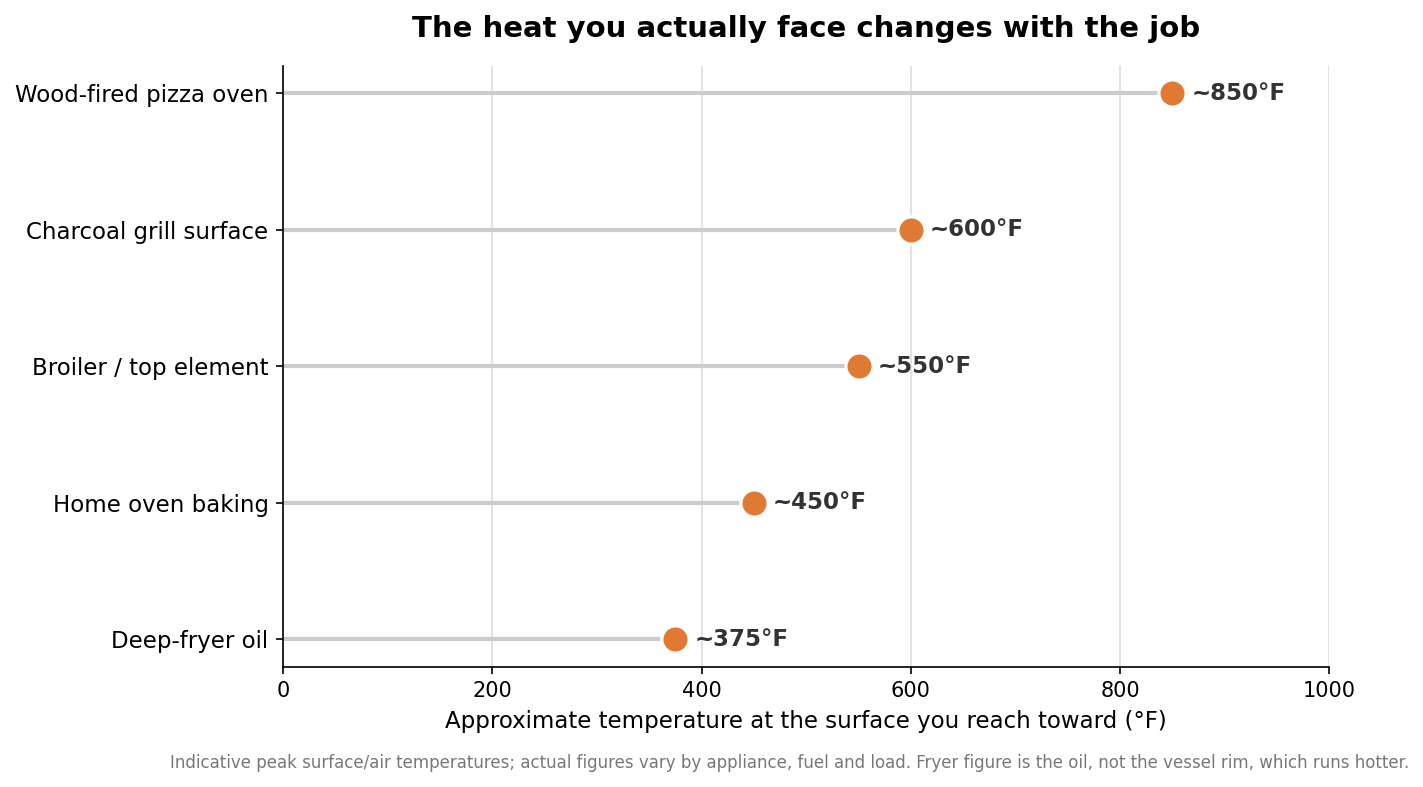
The lesson from that spread is that a single mitt rarely covers a whole cooking life. Someone who only bakes is well served by one thing; someone who bakes on weekdays and runs a kamado grill on weekends needs to think about the grill, because that is where the mitt will be tested. Buy for the peak, not the routine.
Everyday baking and roasting, up to about 450°F
For sheet pans, casserole dishes, and Dutch ovens coming out of a conventional oven, a quilted cotton mitt with a dense fill does the job. The protection here comes less from any exotic material and more from thickness and dead air. A single-layer quilted cotton mitt is typically rated to around 425°F for brief contact, while a double-thick construction with roughly 400 grams per square meter of fill pushes that closer to 500°F. The trade-off is dexterity: more fill means a bulkier mitt and a clumsier grip on a thin pan lip.
Silicone shells occupy a similar band, generally rated in the 400 to 500°F range, and they earn their place through grip and moisture resistance rather than raw heat tolerance. A silicone exterior sheds spills and grease and grabs a wet pot far better than dry cotton, which is why they show up in kitchens that deal with steam and liquid. Where they fall short is breathability and the way solid silicone can trap and hold heat against the hand on a long carry.
Broilers and grills, past 500°F
Once you are working over live coals or under a broiler, the everyday quilted mitt is out of its depth, and the failure is rarely dramatic. It is a slow warming that becomes a burn when you hold a grate a beat too long. This is the zone where cuff length starts to matter as much as the palm. A short mitt leaves the forearm exposed to the reach across a hot grill, and forearm burns are one of the most common grilling injuries precisely because the mitt ended at the wrist. A gauntlet-style mitt or glove with 13 to 18 inches of coverage keeps the reach safe.
Material also has to change at this point. Cotton chars and silicone approaches its ceiling, so serious grilling and rotisserie work moves to aramid-blend gloves, the Nomex and Kevlar family, which are commonly rated to 900°F and beyond for short contact. These are the same fibers used in firefighting and motorsport, and they trade some of the plush feel of a padded mitt for a thinner, more flexible barrier that shrugs off flame contact.
Pizza ovens and open flame, where fabric gives up
A high-heat pizza oven is a different animal. Launching and turning a pie means putting your hand near a 700 to 900°F deck for seconds at a time, repeatedly, and the cumulative exposure is what gets people. Neither a quilted cotton mitt nor a silicone shell belongs here. This is aramid territory, and even then the working rule is speed: the rating tells you what the glove survives, not how long your skin stays comfortable inside it. A glove rated to 900°F still transmits heat over time, so the safe technique is brief, deliberate contact rather than a slow grip.
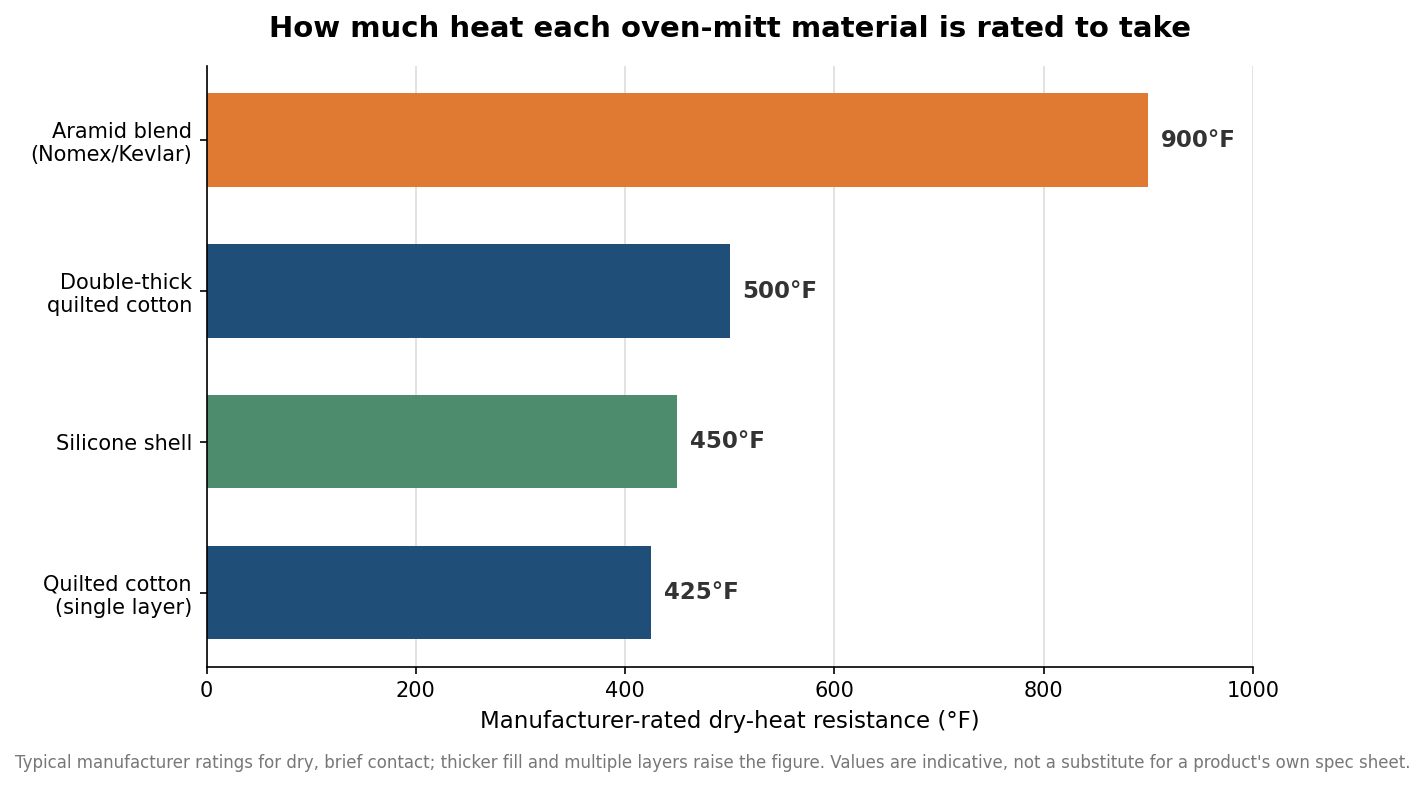
The chart above lines up the common materials against the heat they are built to take, and the gap between the fabric options and the aramid blend is the whole story. There is no fabric-versus-aramid middle ground that quietly covers both a Sunday roast and a pizza oven. If your cooking spans that range, the honest answer is two different mitts, each right for its end of the scale, rather than one compromise that is mediocre at both.
Specifying a custom mitt that matches the job
When the mitt is going to carry a logo or a brand, the temptation is to choose on looks and let the print drive the decision. The better sequence is to fix the function first and then print on whatever material the job demands. Start with the peak temperature the recipient will actually face, pick the material band that covers it with margin, then set the cuff length to the reach, and only then think about decoration. A restaurant merch mitt that will live next to a 500°F oven has different requirements than a promotional mitt destined for home bakers, and pretending they are the same product is how giveaways end up unused.
Two practical notes on the printing itself. Silicone takes debossed or molded branding and screen print cleanly, which is why branded silicone mitts read so sharply. Quilted cotton is the natural home for embroidery and larger printed panels, giving more room for a full design. Aramid gloves are the hardest to decorate because the fiber and the safety rating both resist added coatings, so branding on true high-heat gloves is usually a woven label or a small mark rather than a full wrap. Deciding the material by the heat first keeps you from promising a print the safe material cannot carry.
None of this requires a laboratory. It requires being honest about the hottest thing the mitt will touch and refusing to let a 425°F mitt wander into 850°F work. Match the material and the cuff to that peak, and the rest, including how good the branding looks, follows without a fight.