Two oven mitts can look nearly identical on a shelf and protect your hands in completely different ways. The choice between a silicone shell and a quilted cotton mitt is not really about which is better in the abstract — it is about which failure mode you are willing to live with, because each material is excellent at exactly the thing the other one is bad at. Line them up on the specs that matter in a working kitchen and the decision usually makes itself.
Heat rating: where each material actually lands
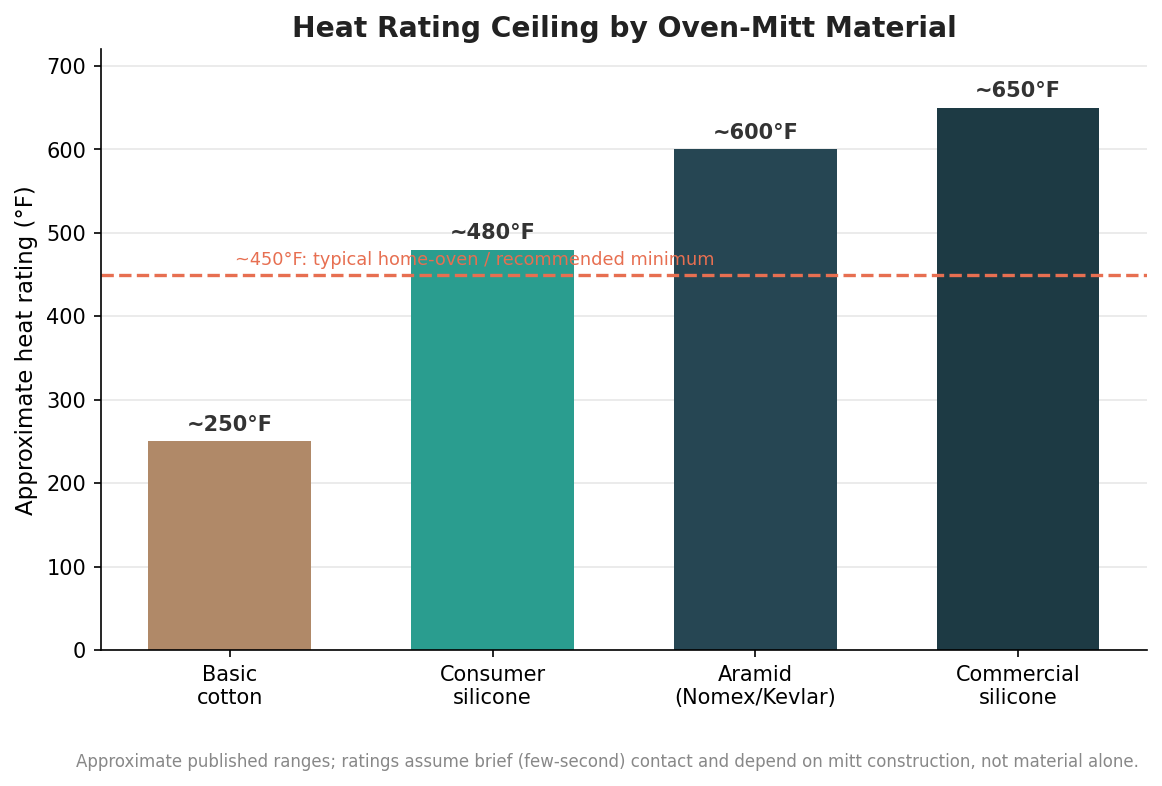
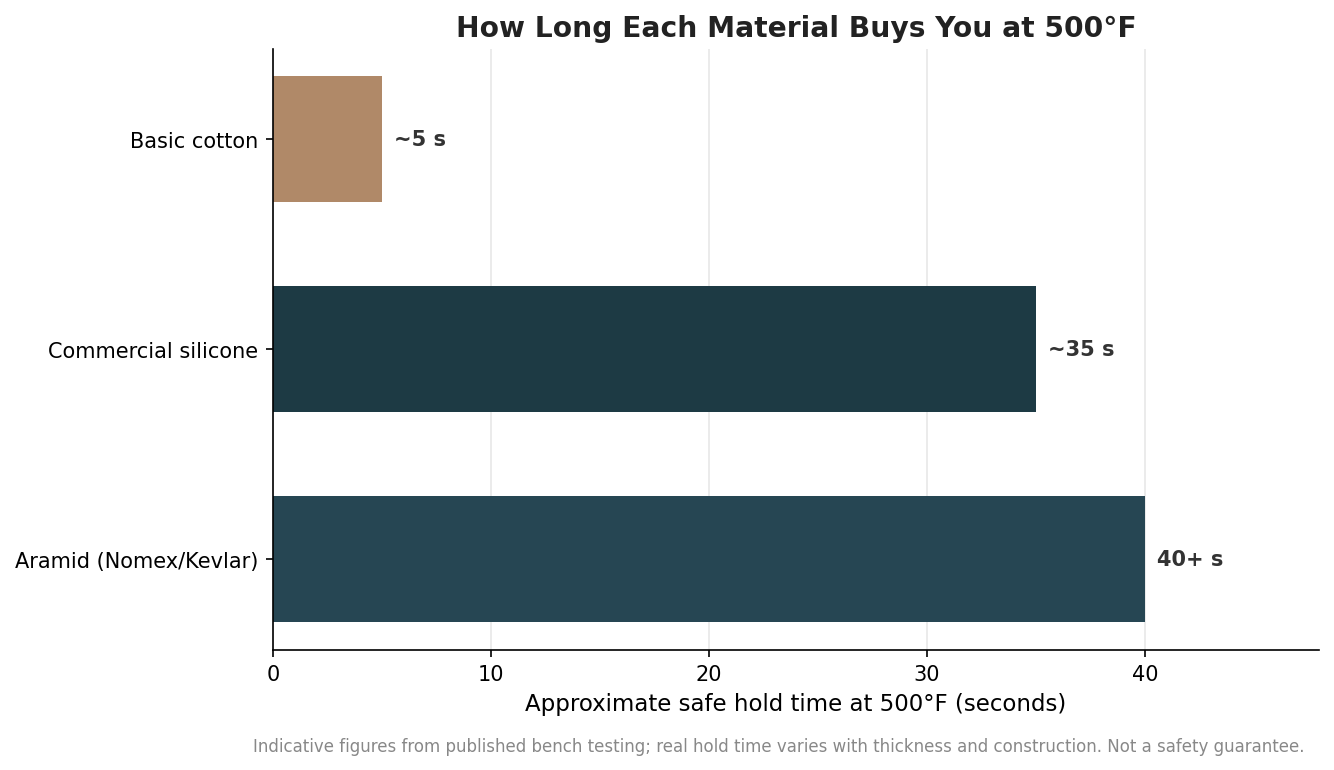
Start with the number everyone asks for, then read the fine print on it. Basic cotton mitts are often rated only in the range of roughly 200 to 250°F, which is why a thin cotton mitt is fine for a warm plate and frightening on a 450°F roasting pan. Consumer silicone typically lands around 446 to 500°F, and commercial-grade silicone climbs to roughly 600 to 685°F. Aramid fibers — the Nomex and Kevlar blends used in professional mitts — are rated 600°F and above. The catch is that every one of these ratings assumes brief contact, a few seconds, not a firm grip on a hot rack while you wrestle a turkey out of the oven. In bench testing, a basic cotton mitt gave only about five seconds of safe hold at 500°F, while commercial silicone managed around thirty-five seconds and aramid past forty. For a home kitchen, a practical target is a mitt rated in the 400 to 450°F range, chosen 50 to 100°F above the temperature you actually cook at so there is a buffer.
The steam problem: why wet fabric burns
The most important difference between the two materials is what happens when they get wet. Silicone is non-porous, so it simply does not absorb water or let steam through — grab a dripping pot or lift a lid into a cloud of steam and the barrier holds. Cotton is absorbent, and a damp fabric mitt is not merely less effective, it is actively dangerous: water conducts heat far faster than the trapped air that makes a dry mitt insulating, so a wet spot turns the mitt into a direct path to your skin. This is the single most common way a fabric mitt burns someone — not because the oven was too hot, but because the mitt was damp from a wiped counter or a splash. If your kitchen deals with steam, wet lids, or blanching pots routinely, silicone’s imperviousness is a genuine safety advantage rather than a preference.
Grip and dexterity: the everyday trade-off
Where fabric earns its place is feel. A quilted cotton mitt is thinner and more flexible, so you can sense the edge of a sheet pan, pinch a small ramekin, and work with a natural dexterity that a thick silicone mitt does not allow. Silicone, in exchange, grips. Its textured, tacky surface holds a greasy handle or a smooth ceramic dish that a slick cotton mitt would let slide, but the same bulk that provides that grip deadens your touch and makes fine tasks clumsier. The honest summary is that fabric feels like an extension of your hand and silicone feels like a tool — better for lifting a heavy Dutch oven, worse for anything delicate.
Cleaning, hygiene, and how long they last
This is where silicone quietly wins for a lot of buyers. Because it does not absorb anything, a silicone mitt wipes clean under the tap, sheds grease and sauce, dries in seconds, and often goes in the dishwasher. A cotton mitt soaks up cooking oils, drippings, and moisture, which means it needs regular laundering, takes time to dry, and can hold odors and bacteria in the fibers between washes. For a food-service setting where cross-contamination and quick sanitizing matter, that difference is more than cosmetic, and it can factor into passing a health inspection. There is a durability angle too: a cotton mitt gradually thins and compresses at the fingertips with every wash cycle, slowly losing insulation where you need it most, while a silicone shell holds its shape and thickness far longer. Fabric mitts are not disqualified — plenty of kitchens simply keep a couple in rotation and launder them — but if low-maintenance hygiene is a priority, silicone is the lower-effort material over the life of the mitt.
Branding, cost, and why hybrids exist
For anyone ordering custom, the decoration surface and the price round out the decision. Quilted cotton is a fabric, so it takes full-surface printing readily — a large logo, edge-to-edge patterns, and full color are all straightforward, which is why promotional and gift mitts lean cotton. Silicone is harder to decorate: logos are usually molded, debossed, or applied in a limited way, and full-color graphics are not its strength. Silicone shells also tend to cost more per unit than a comparable quilted cotton mitt, with aramid and commercial-grade options higher still; treat any figures as indicative of the market rather than a quote, since construction, lining, and quantity all move the number. This split in strengths is exactly why the hybrid design has become so common — a silicone outer shell for grip and steam protection over a cotton or terry lining for comfort and insulation, printed where the fabric shows. If you find yourself wanting silicone’s steam resistance and cotton’s feel and printability at the same time, the hybrid is the answer the market already settled on. Otherwise, decide which single failure you least want to risk — a slippery grip, a steam burn, a clumsy touch, or a mitt you have to launder — and let that pick the material for you.