Almost every oven mitt on the market carries a temperature number, usually something confident like “heat resistant up to 500°F.” On its own, that number tells you less than it appears to. A rating without a time attached, and without saying which kind of heat it was measured against, is closer to marketing than to specification. Understanding what sits behind the figure is the difference between buying a mitt that protects the hand it is on and buying one that fails the first time someone holds a hot rack a second too long.
A temperature with no time is only half a rating
Heat protection is always a race between temperature and time. Any material touching something hot will eventually transmit that heat to the skin underneath; the only question is how long it takes. A quality mitt might comfortably let you hold a 400°F pan for up to about ten seconds, which is plenty to move a tray from oven to counter, and yet the same mitt would burn you if you gripped that pan for a full minute. That is why a bare temperature figure is incomplete. The honest version of a heat rating names a temperature and the number of seconds before the inside gets dangerous, because those two numbers together describe what actually happens to the hand.
Three kinds of heat, and why one number can’t cover them
Kitchens deliver heat in three different ways, and a mitt can be excellent at one and poor at another. Contact heat is the obvious one: your palm pressing a cast-iron handle or a metal rack. Convective heat is the hot air and steam that wash over your forearm when you reach deep into an oven or lift a lid, and it is what scalds skin the mitt is not even touching. Radiant heat is the invisible energy thrown off by a glowing broiler element or a grill, which heats the outer surface of the mitt without any contact at all. A thick silicone shell can be superb against a brief press on a hot pan while doing little to stop steam from finding the gap at the cuff. This is exactly why the international standard for thermal gloves does not issue a single grade. It scores several kinds of heat separately.
How EN 407 puts a number on contact heat
EN 407:2020 is the European standard for protective gloves against thermal risks, and it is the most rigorous framework a consumer mitt is likely to be measured against. It assesses six separate properties: flame spread, contact heat, convective heat, radiant heat, and small and large splashes of molten metal. The last two matter to foundry workers rather than home cooks, but the contact-heat scale is directly useful. It runs in four levels, and the level is set by the temperature of a heated plate held against the material until the inside surface rises ten degrees Celsius, a threshold that must take at least fifteen seconds to reach.
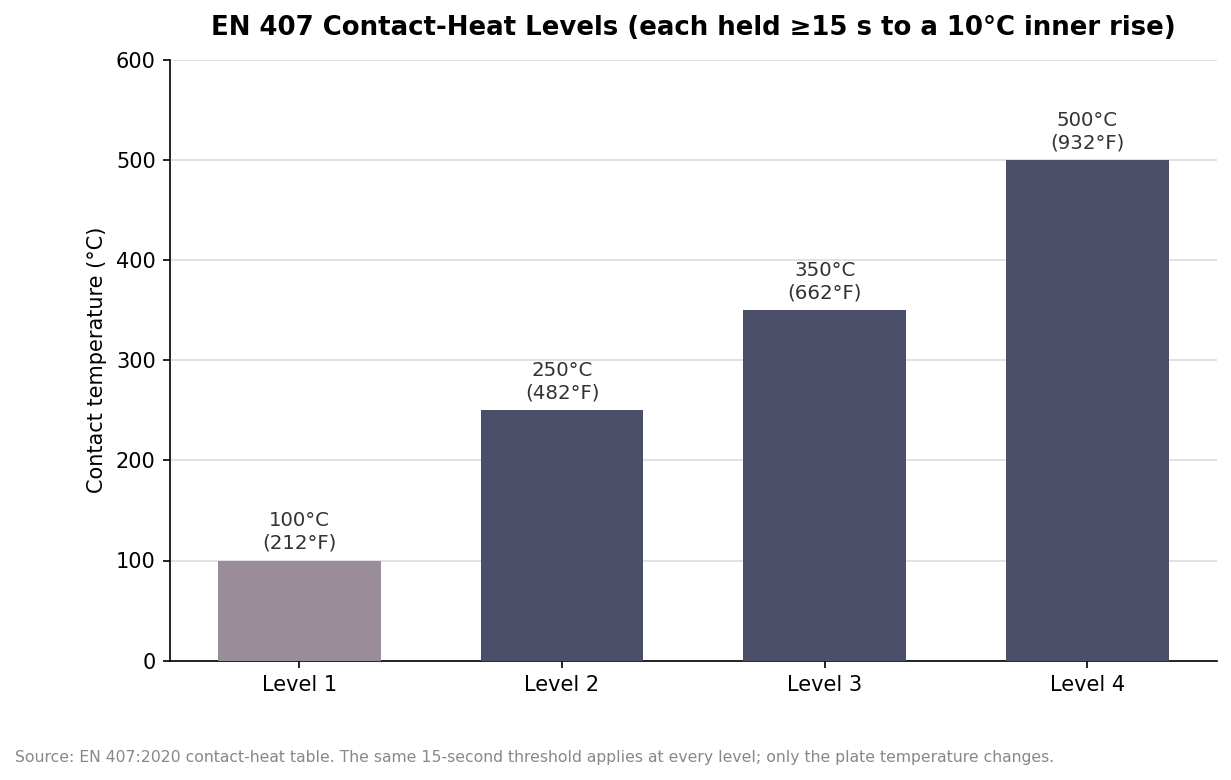
The detail worth absorbing is that the fifteen-second threshold is the same at every level. What changes between Level 1 and Level 4 is only the plate temperature, from a modest 100°C up to a serious 500°C. So a Level 4 contact rating is not a vague promise of toughness; it means the material held back a 500°C surface for at least fifteen seconds before the inside climbed ten degrees. That is a real, repeatable claim, which is precisely what a bare marketing number is not. The convective and radiant scales work on a similar logic, expressed as a heat-transfer index in seconds, so a fuller EN 407 result reads as a string of separate scores rather than one headline figure.
Translating a “500°F” claim
Most American-market mitts quote Fahrenheit and skip the standard entirely, so it helps to see where those claims land. A common silicone rating of “up to 450°F” and an aramid mitt’s “up to 500°F” both sit around the 230 to 260°C mark, which is roughly EN 407 contact Level 2 territory rather than the Level 4 ceiling. That is not a criticism; Level 2 is entirely adequate for pulling bakeware. The number that should raise an eyebrow is the occasional dramatic claim, such as an aramid mitt rated to “over 900°F,” because that figure typically holds only for a burst of around sixteen seconds, not for sustained gripping. Reading the claim against the standard keeps the marketing honest.
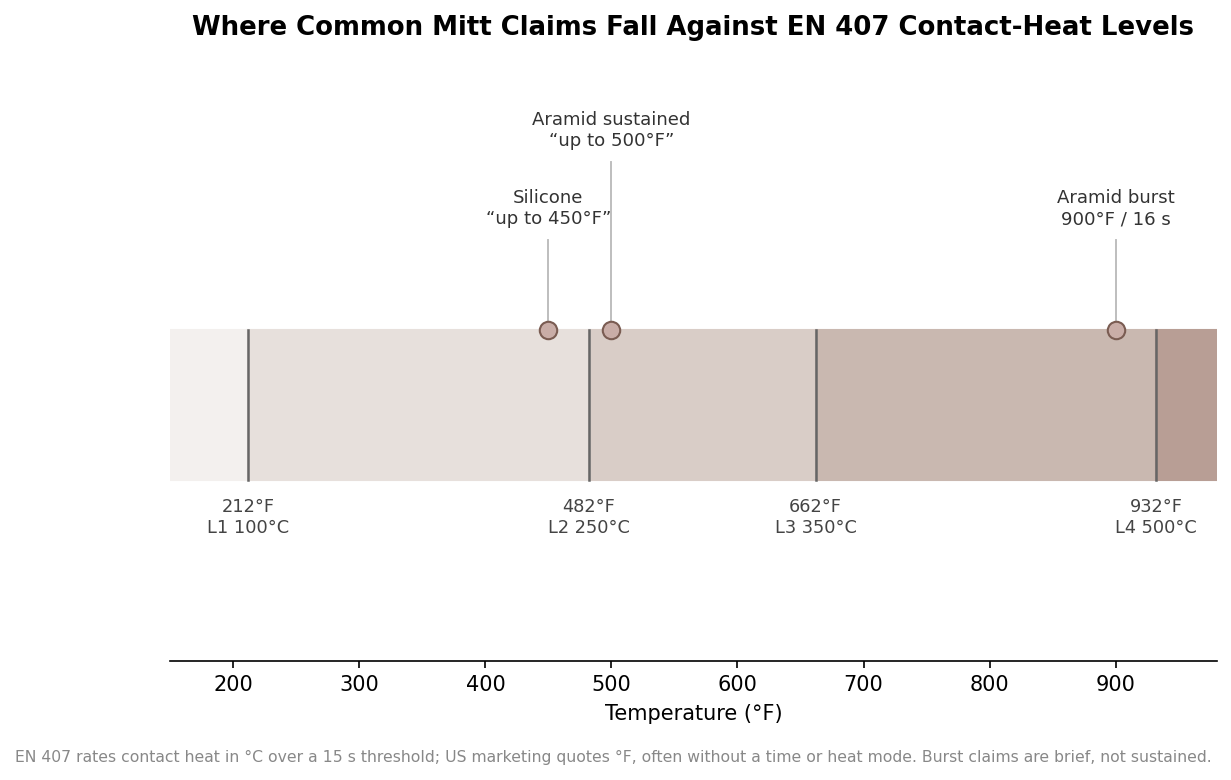
The mapping makes two things clear. First, the everyday silicone and aramid claims cluster in the same practical band, so a bigger Fahrenheit number does not automatically mean a meaningfully safer mitt for normal cooking. Second, the extreme ratings live far to the right of anything a home oven produces, and they usually come with a short time limit in the fine print. When you see a peak temperature, look immediately for the seconds beside it; if there are none, treat the figure as a best case rather than a working spec.
The rating you actually need
Match the rating to the work, not to the biggest number on the label. A home baker moving trays and Dutch ovens between a 350 to 450°F oven and the counter is well covered by a mid-level contact rating, provided the cuff is long enough to guard the forearm against the convective heat that causes so many burns. Someone running a busy commercial line, handling pizza-oven peels or pulling pans hour after hour, has a genuine case for a higher contact rating and for materials like aramid that tolerate brief flame exposure, and they should also weigh how the mitt launders, since a commercial mitt is washed constantly and a rating means nothing once the padding has matted down. For most buyers, though, the useful takeaway is simpler: a temperature you can trust comes with a time, describes the kind of heat it was tested against, and covers enough of the arm to matter. A number standing alone, however large, is only half the story.